
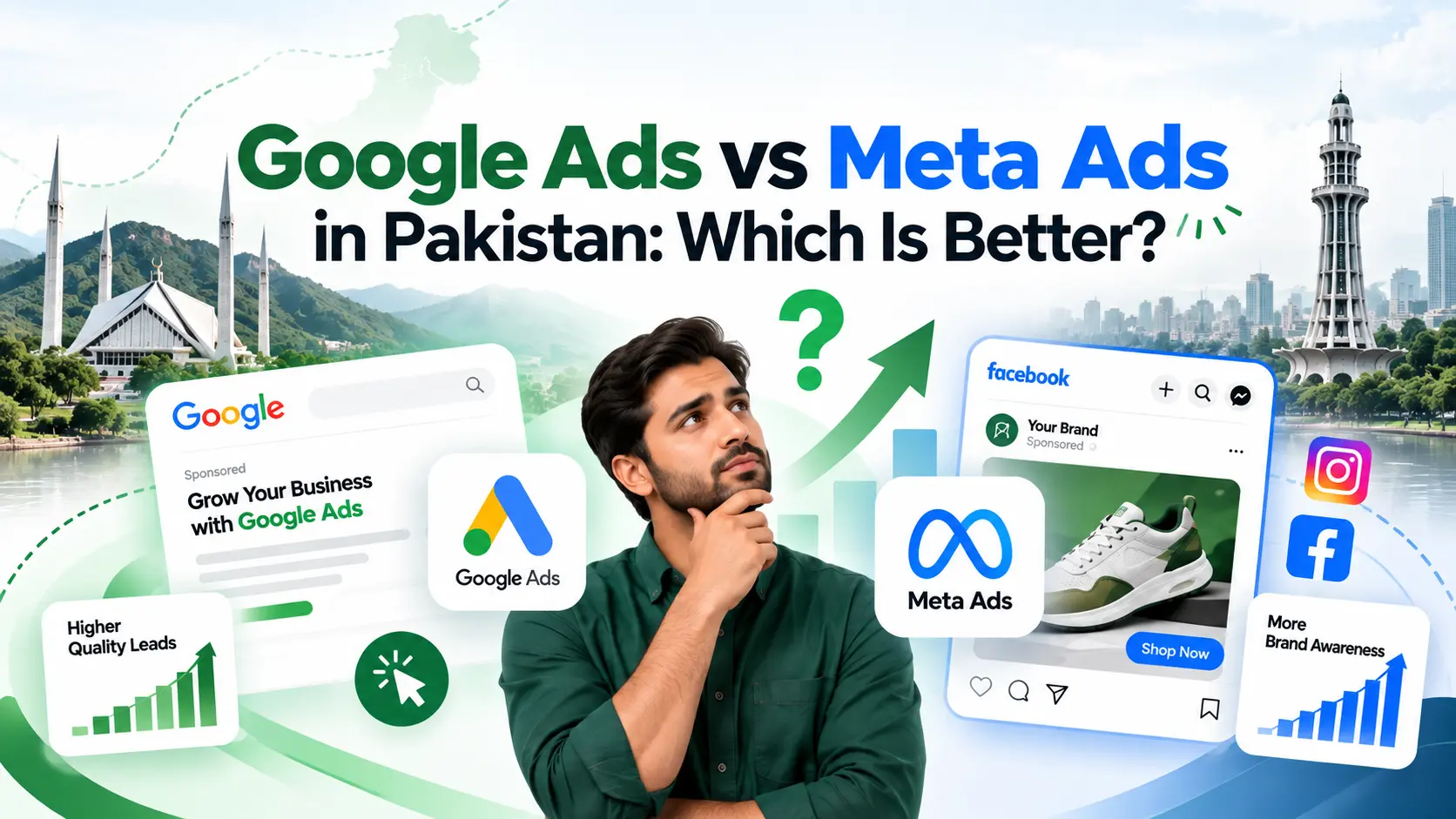
Choosing between Google Ads and Meta Ads in Pakistan is not simply a question of which platform offers cheaper clicks. The decision depends on how customers find your business, how they evaluate your offer and how much you can afford to spend acquiring a profitable customer.
A business receiving inexpensive enquiries can still lose money if those enquiries rarely become customers. Another business may pay more for each lead but achieve a better return because its enquiries are relevant and its sales process works.
This guide explains the differences between Google Ads and Meta Ads, when each may be a useful starting point and how to compare performance using qualified leads, sales and profit. It also includes hypothetical PKR examples to help you evaluate your own advertising economics.
Quick Answer: Should You Choose Google Ads or Meta Ads?
Start with Google Search ads when customers already search for your product or service and you can identify relevant commercial queries. Consider Meta Ads when images, demonstrations, offers or educational content can introduce your business to suitable customers. Test the platform that best matches the buying journey, then compare qualified leads, customers and profit before expanding.
Using both can be useful when each has a clear role. It is not automatically the right choice for a small budget.
Google Ads vs Meta Ads: The Main Differences
| Factor | Google Search ads | Meta Ads |
|---|---|---|
| How people encounter the ad | While searching for a relevant topic, product or service | While using Facebook, Instagram and other available placements |
| Useful starting situation | Existing demand expressed through relevant searches | Discovery, demonstrations and audience-based prospecting |
| Message requirements | Answer the need expressed in the search | Earn attention and explain why the offer matters |
| Creative requirements | Relevant search copy and a suitable destination | Images, videos, copy and suitable destinations |
| Common measurement risk | Counting irrelevant searches or low-value actions as success | Counting cheap responses without checking qualification |
| Business outcome to compare | Qualified leads, acquired customers and profit | Qualified leads, acquired customers and profit |
This comparison focuses on Google Search ads. Google Ads is a broader platform with multiple campaign types. Performance Max, for example, can access several Google channels within one campaign. Its behavior should not be treated as identical to a Search-only campaign.
1. Understand Demand Capture and Product Discovery
Google Search ads can connect your offer with a need someone has expressed through a search. Meta Ads can introduce an offer while someone is browsing or consuming content.
Consider a business searching for “commercial courier service Lahore.” That search gives an advertiser information about the user’s current interest. A relevant ad and landing page can explain service coverage, delivery options and how to request a quote.
Now consider a shopper who sees a video demonstrating a useful kitchen product on Instagram. The shopper may not have searched for that product previously. The demonstration helps explain the benefit and can create interest.
These are different starting points, but neither guarantees a sale. Some searches are informational, and some people seeing a Meta ad already know the brand and are ready to buy.
Ask These Questions Before Choosing a Platform
- Do suitable customers already search for this offer?
- Can the offer be explained effectively in a short visual format?
- Does the customer need an immediate solution or a longer evaluation?
- What information is required before someone can enquire or buy?
- Can the business measure what happens after the first response?
For campaign planning and management, explore our Google and Meta Ads services.
2. When Google Search Ads May Be the Better First Test
Google Search ads may be a useful starting point when the search query clearly describes a service or product you provide.
Examples include searches for a specific repair service, a software implementation partner or a web development provider. Before launching, check whether relevant searches exist in your target market and whether the search results reflect the intended buying need.
Illustrative Example: A Website Development Company
A company offering ecommerce development might investigate searches such as “ecommerce website development Pakistan” and “Shopify development services.” Its landing page should explain the platforms supported, project scope, process, evidence and next action.
If its ads also attract people looking for tutorials, jobs or free templates, the agency should investigate whether those queries belong in the campaign. Negative keywords can help exclude unsuitable searches, but exclusions must be reviewed carefully to avoid blocking relevant demand.
The decision should be based on actual search terms and enquiry outcomes, not just impressions or clicks.
3. When Meta Ads May Be the Better First Test
Meta Ads may suit an offer that benefits from demonstrations, visual comparison, customer education or repeated exposure.
A product demonstration can show how an item works. A service video can explain a problem buyers recognize. A clearly described offer can encourage suitable people to submit a form or start a conversation.
Illustrative Example: A Home Decor Store
A store can demonstrate a product in a real room, show its dimensions and explain ordering and delivery. Different creative concepts can test different buying concerns, such as appearance, space, maintenance or gifting.
The purpose is not simply to produce attractive images. The creative should communicate why the product is relevant and what the customer should expect after clicking.
For businesses developing the wider content and social presence around their campaigns, explore our social media marketing services.
4. Which Platform Produces Better Leads?
Lead quality depends on targeting, messaging, qualification and follow-up. Google does not automatically produce high-quality leads, and Meta does not automatically produce poor-quality leads.
Define a qualified lead before comparing campaigns. A useful definition for a service business may include:
- The person needs a service you actually provide.
- The project is within your delivery area or target market.
- The expected scope fits your business.
- The person has a realistic timeframe.
- The enquiry can progress into a genuine sales conversation.
Qualification requirements should match the business. A clinic booking, a courier enquiry and an enterprise software opportunity need different criteria.
Hypothetical PKR Lead Comparison
The following figures demonstrate the calculation. They are not market averages, platform forecasts or Prime Marketing client results.
| Metric | Campaign A | Campaign B |
|---|---|---|
| Advertising spend | PKR 40,000 | PKR 40,000 |
| Total enquiries | 80 | 25 |
| Cost per enquiry | PKR 500 | PKR 1,600 |
| Qualified leads | 8 | 10 |
| Cost per qualified lead | PKR 5,000 | PKR 4,000 |
| New customers | 2 | 4 |
| Advertising cost per customer | PKR 20,000 | PKR 10,000 |
Campaign B has the higher cost per enquiry but the lower advertising cost per customer. The better commercial result still depends on customer value and the cost of delivering the service.
Use the same qualification rules and comparable follow-up periods for both campaigns. Otherwise, you may be comparing a mature group of leads with one that has not had time to convert.
5. Improve the Lead Process Before Increasing Spend
If enquiries are unsuitable or rarely convert, investigate the entire process before blaming the platform.
- Ad promise: does it describe the actual offer?
- Qualification: are the questions sufficient and appropriate?
- Destination: does the page or form explain important conditions?
- Handover: do leads reach the responsible person reliably?
- Follow-up: does the team respond consistently?
- Outcome records: are reasons for rejection or lost sales documented?
Meta instant forms can collect enquiries without sending people to a website. That convenience can be useful, but it does not replace clear questions and an effective follow-up process.
A form asking for more information may improve qualification, but additional friction can also reduce responses. Test the balance instead of assuming the longest form is best.
6. Google Ads vs Meta Ads for Ecommerce in Pakistan
Ecommerce businesses should compare customer acquisition against the economics of delivered orders.
Google Search can capture relevant product searches. Other Google retail formats may be useful where the business, products and target market meet the relevant eligibility requirements. Verify current availability before building the plan around a particular campaign format.
Meta can help shoppers discover products through images, videos and demonstrations. Clear information about price, sizing, delivery, payment and returns can reduce misunderstandings before an order is placed.
Why Cash-on-Delivery Outcomes Matter
For a store offering cash on delivery, placed orders and delivered orders are not the same result. Cancellations, refused deliveries and returns can materially change profitability.
Compare campaigns using records that distinguish:
- Orders placed.
- Orders confirmed.
- Orders dispatched.
- Orders delivered and paid.
- Returns and refunds.
If the campaign is credited with every placed order while many do not generate revenue, the reported return may overstate the business result.
Hypothetical Ecommerce Profit Calculation
Assume a delivered order produces PKR 5,000 in revenue. Product cost, packaging, payment and delivery costs total PKR 3,500. That leaves PKR 1,500 before advertising and other business expenses.
At an advertising cost of PKR 1,200 per delivered order, PKR 300 remains before overheads and any costs not included above. A campaign can therefore show an attractive revenue-to-ad-spend ratio while leaving a small contribution.
The simplified break-even advertising ROAS is approximately 3.33 in this example: PKR 5,000 divided by PKR 1,500. Operating profit requires room for other expenses as well.
Use your own net revenue and cost records. Do not copy a generic ROAS target without checking margins.
7. Which Platform Is Better for Local Services?
For local services, investigate existing search demand and the role of visual or educational content.
A customer urgently seeking a repair provider may use Google Search. A customer considering a planned renovation may respond to Meta content showing the process and finished work.
Whichever channel you use, state your service area clearly and review whether enquiries match it. Also check that the advertised service is available when the customer needs it.
A campaign producing calls outside your coverage area can look successful in the dashboard while creating little business value.
8. Which Platform Is Better for B2B Businesses?
B2B campaigns often need to support a longer evaluation. Google Search may reach buyers describing a specific requirement. Meta may help introduce an offer, explain a problem or bring a business back into consideration.
Compare opportunities and customers, not just brochure downloads or initial forms. Ask whether leads belong to suitable organizations and whether they progress into meaningful conversations.
When the sales cycle is long, report lead cohorts by acquisition period. A lead created yesterday should not be judged against a lead that has had several months to close.
9. How Much Do Google Ads and Meta Ads Cost in Pakistan?
There is no universal cost per click, lead or sale for Pakistan. Auction competition, market, creative, offer, campaign settings and conversion performance all affect the result.
Request estimates that state their assumptions. A forecast should identify the intended audience or queries, expected conversion behavior and the data used. It should not be presented as a guaranteed outcome.
Separate these cost categories:
- Advertising spend paid to the platform.
- Campaign management.
- Creative production.
- Landing-page work.
- Tracking and CRM integration.
- Applicable taxes and transaction charges.
Comparing media spend alone can hide differences in the complete cost of running the campaigns.
Calculate an Affordable Lead Cost
A useful starting calculation is:
Planning cost per qualified lead = allowable acquisition cost per customer × qualified-lead-to-customer rate.
For example, if the business can allocate PKR 10,000 to acquire a customer and historically converts 20% of qualified leads, the planning allowance is PKR 2,000 per qualified lead.
This is a simplified planning estimate. Decide whether the acquisition allowance includes management and creative costs, and leave room for uncertainty. Historical conversion rates may not continue when the audience or campaign changes.
10. Set Up Tracking for Meaningful Outcomes
Track what happened after the click. Useful outcomes may include completed bookings, qualified enquiries, delivered orders or paid customers.
A phone-button click does not prove a completed call. A WhatsApp click does not prove a qualified conversation. Use those actions as supporting indicators unless you can connect them to confirmed outcomes.
Google supports qualified and converted lead goals. Enhanced conversions for leads can support the connection between advertising interactions and later outcomes through eligible first-party data implementations.
Meta’s Conversions API for CRM can feed downstream lead information into measurement and optimization. Both approaches require correct setup, suitable data and compliance with platform requirements and applicable privacy obligations.
Measurement technology does not guarantee better customers. The campaign must still optimize toward a useful outcome and receive reliable data.
For help assessing measurement requirements, explore our tools and analytics services.
11. Understand Attribution Before Combining Reports
A customer may encounter Meta content, search on Google and then buy. Depending on each platform’s attribution settings, both may report credit for the same sale.
Do not add all platform-reported purchases and assume they are unique orders. Reconcile reports with your store, booking system or CRM.
When comparing platforms, document:
- The conversion being measured.
- The attribution window.
- Whether view-based credit is included.
- How duplicate transactions are identified.
- How cancellations and refunds are handled.
Attributed revenue is a reporting result. It is not, by itself, proof that every sale was caused by advertising. More rigorous incrementality testing may be useful when the business has sufficient scale and resources.
12. Prepare the Landing Page or Lead Destination
The destination should continue the promise made in the ad.
For a website campaign, check that visitors can quickly understand the offer, determine whether it suits them and complete the next action.
- Use a headline aligned with the ad.
- Explain important deliverables or product details.
- Show genuine evidence and accurate business information.
- Make forms and buttons comfortable to use on mobile.
- Test submissions and notification delivery.
- Explain relevant pricing, coverage or delivery conditions.
For messaging campaigns, prepare the response process. For instant forms, explain what happens after submission and ensure leads reach the responsible team.
If website improvements are needed, explore our web development services.
13. Build a Focused Campaign Test
A useful test begins with a clear hypothesis. For example: “Relevant service searches will produce qualified enquiries within our acquisition allowance,” or “Product demonstration videos will generate profitable delivered orders.”
- Select one priority offer: choose an offer with clear business value and sufficient delivery capacity.
- Choose the initial channel: use customer behavior, existing demand and available creative.
- Define success: agree on qualification, customer outcomes and economic limits.
- Prepare the destination: verify the page, form or conversation process.
- Test tracking: check that meaningful events are recorded correctly.
- Document the campaign: record assumptions, budget and major changes.
- Review mature outcomes: allow appropriate time for qualification and sales.
There is no universal test duration or budget. Plan around expected conversion volume, sales-cycle length and financial tolerance. Set a maximum test spend and stop early when a confirmed technical fault or clearly unsuitable traffic requires correction.
A comparison using different offers, locations and follow-up standards is not a clean platform comparison. Record those differences when interpreting results.
Should You Run Google Ads and Meta Ads Together?
Consider both when you have evidence that each can contribute and enough resources to manage the additional work.
One possible arrangement is to use Meta for product demonstrations and Google Search for relevant buying queries. Retargeting may support follow-up where audience size, eligibility and permissions allow it.
However, customers do not all follow the same sequence. The combined plan should have defined goals, appropriate measurement and safeguards against double-counting.
For coordinated planning, explore our performance marketing services.
Common Mistakes That Make Either Platform Look Worse
- Optimizing for the wrong action: treating clicks or low-value submissions as the main business result.
- Unclear messaging: attracting people whose expectations do not match the offer.
- Broken handover: allowing enquiries to disappear between the form and sales team.
- Premature conclusions: declaring success or failure from a few responses.
- Unrecorded changes: changing several variables without documenting them.
- Ignoring economics: assessing revenue without margins, returns and operating costs.
- Ignoring capacity: increasing spend when the business cannot serve additional customers reliably.
Frequently Asked Questions
Is Google Ads better than Meta Ads in Pakistan?
Neither is universally better. Relevant search demand may favor Google Search, while visual discovery or product education may favor Meta. Compare qualified leads, customers and profit using your own campaign data.
Which platform generates cheaper leads?
The answer varies by business and campaign. Cheap enquiries may be unsuitable, so compare cost per qualified lead and acquired customer as well.
Can Meta Ads generate leads without a website?
Yes. Supported instant-form formats can collect lead information within Meta experiences. An effective qualification and follow-up process is still necessary.
Is Google Ads only search advertising?
No. Google Ads includes multiple campaign types. Performance Max can serve across several Google channels, so campaign type matters when evaluating performance.
How much should a small business spend?
Build the test budget around your offer, expected customer value, conversion assumptions and financial tolerance. A fixed amount recommended for every business is not a reliable plan.
What should a cash-on-delivery store measure?
Track placed, confirmed and delivered orders, plus cancellations and returns. Evaluate profitability using realized revenue and relevant fulfilment costs.
Does higher ROAS always mean higher profit?
No. ROAS compares attributed revenue with advertising spend. It does not automatically deduct product costs, delivery, refunds, management fees or overheads.
Can automated campaigns replace human strategy?
Automation can support delivery and optimization, but the business still needs accurate goals, reliable data, suitable creative, a credible offer and an effective sales or fulfilment process.
Should I use both platforms immediately?
Not necessarily. A focused first test may provide clearer evidence. Expand when the outcomes and available resources support another channel.
Choose the Platform That Fits Your Buying Journey
Begin with how suitable customers discover and evaluate your offer. Use that understanding to select a campaign, define meaningful outcomes and run a controlled test.
Judge the result by qualified enquiries, customers and commercial value. The best platform for your business is the one that performs against those requirements, not the one with the most impressive dashboard.
To explore a campaign plan based on your services, customer journey and measurement needs, visit Prime Marketing’s Google and Meta Ads services.
Sources and Further Reading
This guide uses official platform documentation and practical decision frameworks. All numerical examples are hypothetical; they are not Pakistan market benchmarks or client case studies.

